Sunday, January 01, 2012

Welcome to Spiderland

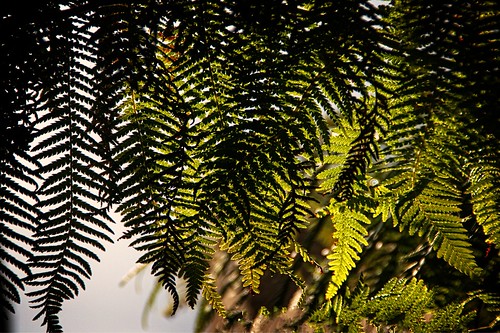
The dry summer heat has started in earnest yesterday and today saw a cloud of insects congregating in my little strip of Gondwanaland enjoying the humid micro climate. Then today with hours the open spaces where criss crossed with new spider webs and judging by the number or holes they had already done battle and eaten a number of those large buzzing blow flys.

BTW the Gondwanaland garden is on the south side of my house and it definitely cools the entrance and lower floor. Natural Air conditioning, at least while this ferny glade restrains some of its natural humidity.
Posted by Picasa

Tuesday, July 19, 2011

returning to gwondanaland


returning to gwondanaland
Originally uploaded by imageo.
It has been a while since I have blogged about my Cretaceous garden, because it has been left to solider on by itself. A classic case of gardening by neglect and in fact it has looked after itself rather well, albeit becoming a touch overgrown.

Admittedly the weather has been very kind, lots of rain, but i am impressed with how fast the ferns have recovered from the drought conditions of the past few years.

Thursday, May 05, 2011

The first art work arrives

IMGP6355Not many gardens boost works of art these days, but Gondwanaland has a new wall hanging. It’s one of the rock panels from my “Retracing Darwin” exhibition fitted out as the new home for an stag horn fern [Platycerium]. The fern is “growing” over my representation of the geological layers representing the Permian mass extinction event. A somewhat poignant reminder of the larger cycles in nature.

I think it looks perfectly at home.

Sunday, February 06, 2011

Wet, Wet, Wet

IMGP0005Well the rains have come (at last) and Gwondanaland is more like a river than a garden. Also some water restriction have been lifted but now no one needs to water their garden.
It is amazing how the ferns have come to life. Everything is gushingly green again

Friday, May 07, 2010

Travelling

IMGP3388-1 My Wollemi pine, is having a vacation. It is part of my Retracing Darwin exhibition down at the Gecko Gallery Studio at Fish creek, That’s the pine in a pot down in the corner amongst the things Charles Darwin didn’t see or describe, when he travelled from Sydney to Bathurst in 1836. From Govert’s Leap Darwin did look out down into the Wollemi national Park. Instead he just complained -

16th. Everywhere we have an open woodland, the ground being partially covered with a most thin pasture. The trees nearly all belong to one family;1 & have the surface of their leaves placed in a vertical instead of as in Europe a nearly horizontal position; This fact & their scantiness makes the woods light & shadowless; although under the scorching sun of the summer this is a loss of comfort, it is of importance to the farmer, as it allows grass to grow where it otherwise could not. — …. It is singular that the bark of some kinds annually falls, or hangs dead in long shreds, which swing about with the wind; & hence the woods appear desolate & untidy. — Nowhere is there an appearance of verdure or fertility, but rather that of arid sterility: — I cannot imagine a more complete contrast

Wednesday, December 03, 2008

In good health

 
My wollemi pine gets its anuual-ish repoting. Compared with other pines here in victoria it is looking healthy with some new growth visiable (probably related to the fact that i still "hand" water it by placing it in a bucket of shower water regularly). However it is starting to look just a little spindly and I am wondering if it is a good idea to prune and if so when? Checking the wollemi website suggests shaping is a good idea and anytime of the year, but sterile secateurs!

Monday, July 28, 2008

Position, Position, Position

Rain gauges, like most meteorological instruments, should be placed IMGP4465far enough away from structures and trees to ensure that any effects caused are minimised. The Nylex Rain Gauge 1000 instruction leaflet suggest the gauge should be located twice as far away as the height of nearby buildings and trees (ie if your house is approx. 3m high then the gauge should be 6m away!) I have two of these rain gauges (normally at different locations) but I have already noted that then can give different readings with only small separation. The main culprit is wind. nearby obstacles can cause shadows and eddies and if the gauges is too exposed eddies in strong winds can carry away up to 20% of the rain. Finding a good site is a standard suburban block can be a challenge and using two gauges (these can be homemade) at various locations is a good way to select best location to permanently mount your rain gauge.
Swalim (the Somalia Water & Land information Management) project has put their comprehensive Rainfall Observers Manual on the net.
The rain gauges that come in most weather station kits are based on tipping buckets. These are generally not as accurate at the conventional graduated cylindrical collectors, for a couple of reasons. A certain amount of rain is needed to tip the buckets and the rain event may finish before the bucket is tipped, where the rainfall is infrequent and low this can be an issue. Also the tripping mechanism may have considerable tolerance (most are made of molded plastic) and it may be wise to "calibrate" the readings against a convention gauge (using a few decent rain events of perhaps 2mm of more)