
Sunday, May 24, 2015

Tuesday, May 05, 2015

Saturday, January 24, 2015
The Rain Forest comes to Gwondanaland
With the water restrictions now largely lifted I decided to re-install some misters and a few drip irrigation points to my little patch of gwondanaland. I had left it pretty much to its own devices over the past few years but the hot weather we often get in february really hit the fern hard over the past couple of years, and I lost a couple of smaller tree ferns and some ground ferns. Hopefully this year the occasional misting will keep my little patch of rain forest vibrant, if nothing else it helps significantly cool the house on those baking hot days,

Friday, January 23, 2015

Saturday, November 22, 2014
A bit of Nostalgia
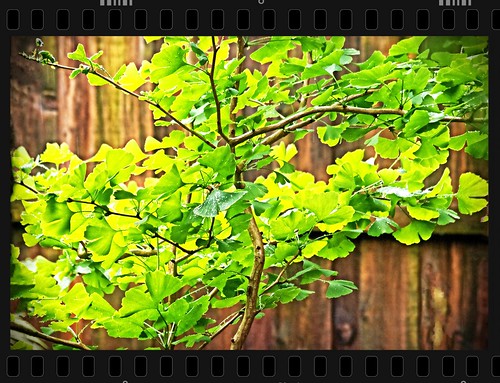
I was experimenting with OnoNe’s Perfect Photo Suite 9 and noticed that amongst the presets is a comprehensive set of slide film emulating filters. Slide film was great it bought a true luminescence to photos, particularly landscapes, but at the same time it was very demanding, even half a stop out and you could "blow the highlights" or a stop under exposed and you would have gloom. However in between was a magic place full of rich colour. Perfect to capture the gingko turning yellow early this year.
Tuesday, November 11, 2014
Thriving under Neglect

The two hot weeks back in febuary really fried the fern (the looked dead) and savaged pretty much everything in my Gwondanaland garden. I did refurbish the irrigation sprays, now that the water restrictions have been eased BUT I haven't used them regulalry instead the garden has had to struggle on under on its own. Well the spring rain bought on some nice new growth on the tree ferns and the gingko. Now everything is looking happy and healthy

Saturday, May 31, 2014
Already the Leaves are turning Yellow

Friday, February 07, 2014

Saturday, September 28, 2013
First leaves on the gingko

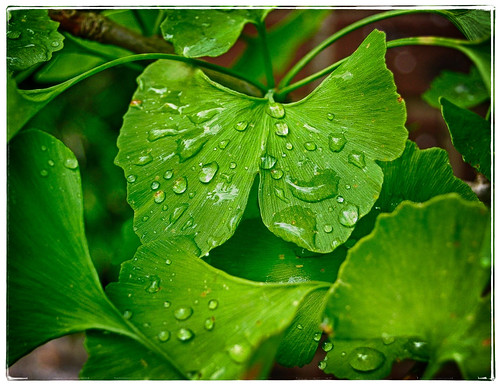
The garden have been left to its own devices ove the past couple of years, and this year I was starting to worry about the gingkpo, which normally sprout a full cover of leaves to welcome spring but this year it was way behind the fruit trees and maples. I'm please to announce the delicate green leaves have appeared (its probably time to plant my tomatoes)
Sunday, January 01, 2012
Welcome to Spiderland
 The dry summer heat has started in earnest yesterday and today saw a cloud of insects congregating in my little strip of Gondwanaland enjoying the humid micro climate. Then today with hours the open spaces where criss crossed with new spider webs and judging by the number or holes they had already done battle and eaten a number of those large buzzing blow flys.
BTW the Gondwanaland garden is on the south side of my house and it definitely cools the entrance and lower floor. Natural Air conditioning, at least while this ferny glade restrains some of its natural humidity.

Tuesday, July 19, 2011
returning to gwondanaland
It has been a while since I have blogged about my Cretaceous garden, because it has been left to solider on by itself. A classic case of gardening by neglect and in fact it has looked after itself rather well, albeit becoming a touch overgrown.
Admittedly the weather has been very kind, lots of rain, but i am impressed with how fast the ferns have recovered from the drought conditions of the past few years.

Admittedly the weather has been very kind, lots of rain, but i am impressed with how fast the ferns have recovered from the drought conditions of the past few years.
Thursday, May 05, 2011
The first art work arrives

I think it looks perfectly at home.
Sunday, February 06, 2011
Wet, Wet, Wet
 Well the rains have come (at last) and Gwondanaland is more like a river than a garden. Also some water restriction have been lifted but now no one needs to water their garden.
It is amazing how the ferns have come to life. Everything is gushingly green again
Friday, May 07, 2010
Travelling

16th. Everywhere we have an open woodland, the ground being partially covered with a most thin pasture. The trees nearly all belong to one family;1 & have the surface of their leaves placed in a vertical instead of as in Europe a nearly horizontal position; This fact & their scantiness makes the woods light & shadowless; although under the scorching sun of the summer this is a loss of comfort, it is of importance to the farmer, as it allows grass to grow where it otherwise could not. — …. It is singular that the bark of some kinds annually falls, or hangs dead in long shreds, which swing about with the wind; & hence the woods appear desolate & untidy. — Nowhere is there an appearance of verdure or fertility, but rather that of arid sterility: — I cannot imagine a more complete contrast

Wednesday, December 03, 2008
In good health

My wollemi pine gets its anuual-ish repoting. Compared with other pines here in victoria it is looking healthy with some new growth visiable (probably related to the fact that i still "hand" water it by placing it in a bucket of shower water regularly). However it is starting to look just a little spindly and I am wondering if it is a good idea to prune and if so when? Checking the wollemi website suggests shaping is a good idea and anytime of the year, but sterile secateurs!
Monday, July 28, 2008
Position, Position, Position
Rain gauges, like most meteorological instruments, should be placed  far enough away from structures and trees to ensure that any effects caused are minimised. The Nylex Rain Gauge 1000 instruction leaflet suggest the gauge should be located twice as far away as the height of nearby buildings and trees (ie if your house is approx. 3m high then the gauge should be 6m away!) I have two of these rain gauges (normally at different locations) but I have already noted that then can give different readings with only small separation. The main culprit is wind. nearby obstacles can cause shadows and eddies and if the gauges is too exposed eddies in strong winds can carry away up to 20% of the rain. Finding a good site is a standard suburban block can be a challenge and using two gauges (these can be homemade) at various locations is a good way to select best location to permanently mount your rain gauge.
Swalim (the Somalia Water & Land information Management) project has put their comprehensive Rainfall Observers Manual on the net.
The rain gauges that come in most weather station kits are based on tipping buckets. These are generally not as accurate at the conventional graduated cylindrical collectors, for a couple of reasons. A certain amount of rain is needed to tip the buckets and the rain event may finish before the bucket is tipped, where the rainfall is infrequent and low this can be an issue. Also the tripping mechanism may have considerable tolerance (most are made of molded plastic) and it may be wise to "calibrate" the readings against a convention gauge (using a few decent rain events of perhaps 2mm of more)
 far enough away from structures and trees to ensure that any effects caused are minimised. The Nylex Rain Gauge 1000 instruction leaflet suggest the gauge should be located twice as far away as the height of nearby buildings and trees (ie if your house is approx. 3m high then the gauge should be 6m away!) I have two of these rain gauges (normally at different locations) but I have already noted that then can give different readings with only small separation. The main culprit is wind. nearby obstacles can cause shadows and eddies and if the gauges is too exposed eddies in strong winds can carry away up to 20% of the rain. Finding a good site is a standard suburban block can be a challenge and using two gauges (these can be homemade) at various locations is a good way to select best location to permanently mount your rain gauge.
Swalim (the Somalia Water & Land information Management) project has put their comprehensive Rainfall Observers Manual on the net.
The rain gauges that come in most weather station kits are based on tipping buckets. These are generally not as accurate at the conventional graduated cylindrical collectors, for a couple of reasons. A certain amount of rain is needed to tip the buckets and the rain event may finish before the bucket is tipped, where the rainfall is infrequent and low this can be an issue. Also the tripping mechanism may have considerable tolerance (most are made of molded plastic) and it may be wise to "calibrate" the readings against a convention gauge (using a few decent rain events of perhaps 2mm of more)
Sunday, July 27, 2008
Handling the pressure
Aneroid Barometers are the most common way to measure atmospheric pressure. But the first barometers use columns of displaced mercury to measure pressure, which is why pressure was originally measured as inches of Mercury (InHg) or millimetres of Mercury (mmHg). At the beginning of the 1900s the millibar (and bar) was introduced as the international measure of atmospheric pressure. Today most instruments give measurements in hectopascals.
The earth atmosphere gets thinner with height, because of the weight of air above it is less. Infact an aneroid barometer can be used to measure altitude. Air pressure gets roughly 1 hectopascal (Hpa) lower for each 10 metres of ascent. To test this I took my reference barometer (a decorative one rather than a highly precise instrument) for a drive up to Olinda in the Dandenong ranges. I got a rough reading from Google Earth that I started at 74m and reached 577m elevation at Olinda (this is most probably several 10s of metres out by the way but I was only interested in relative height difference and have assumed that both estimates are similarly out). The initial reading of the barometer was 1010 HPa and was 960 Hpa after I let it rest for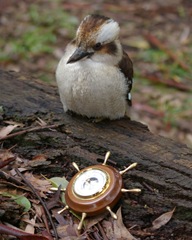 a while on an old tree log at Olinda. An inquisitive Kookaburra took an interest (presumably seeing if it was edible). So there was approx. 500m difference in elevation and the air pressure dropped 50 Hpa. My old barometer seems ok, and a worthy calibration companion for my new weather station.
Most published weather charts show the air pressure at sea level (MSLP, Mean Sea level Pressure) and so it has become a convention to set barometers used in weather prediction to a "relative" pressure at sea level. Normally you can obtain this by finding details of a nearby government weather observatory (BOM Bureau of Meteorology in Australia) and adopting that pressure as your reference. Modern aneroid barometer often have a small adjustments on the back to do this. Digital barometers and weather station usually have a set/calibrate procedure, to change the displayed reading.
The earth atmosphere gets thinner with height, because of the weight of air above it is less. Infact an aneroid barometer can be used to measure altitude. Air pressure gets roughly 1 hectopascal (Hpa) lower for each 10 metres of ascent. To test this I took my reference barometer (a decorative one rather than a highly precise instrument) for a drive up to Olinda in the Dandenong ranges. I got a rough reading from Google Earth that I started at 74m and reached 577m elevation at Olinda (this is most probably several 10s of metres out by the way but I was only interested in relative height difference and have assumed that both estimates are similarly out). The initial reading of the barometer was 1010 HPa and was 960 Hpa after I let it rest for
 a while on an old tree log at Olinda. An inquisitive Kookaburra took an interest (presumably seeing if it was edible). So there was approx. 500m difference in elevation and the air pressure dropped 50 Hpa. My old barometer seems ok, and a worthy calibration companion for my new weather station.
 Most published weather charts show the air pressure at sea level (MSLP, Mean Sea level Pressure) and so it has become a convention to set barometers used in weather prediction to a "relative" pressure at sea level. Normally you can obtain this by finding details of a nearby government weather observatory (BOM Bureau of Meteorology in Australia) and adopting that pressure as your reference. Modern aneroid barometer often have a small adjustments on the back to do this. Digital barometers and weather station usually have a set/calibrate procedure, to change the displayed reading.
Saturday, July 26, 2008
Weather Station Gwondana
 Rather than just think conspiracy theories about the dams and rainfall I figure it might be more constructive to start observing the weather events myself. Surprising it is possible for anyone (with an interest in weather) to do some simple observations themselves and become proficient in local weather forecasting themselves (at least that what the Discover Nature in the Weather websites say).
All that is required is some simples measuring apparatus, and most of that can be homemade if you want. The key items are -
Whilst I have "analogue" version of all these apparatus and know how to use them I was inspired to go "digital" and get a wireless weather station that has an "indoor" LCD control panel, that receives data wirelessly from external mounted measurement devices. Its not a model that can be connected directly to a computer (and then the net) that would make this extravagance way too expensive.
So my weather station is in (just above my cretaceous garden, and over the next few weeks I will be calibrating things. After that you can expect some weather observations to start appearing in here.
Sunday, July 13, 2008
I am not normally a fan of conspiracy theories
Looking at the published levels of stored waters in our dams in Melbourne is a little depressing, it is only just at 30% of capacity at a time when there have been some decent rain events (I have rain gauges and tanks), so is there a conspiracy are we being told the truth?

I started looking to find an independent way to verify this (ie not just looking at one source of data). If you look at the Melbourne Water website they have a graph that shows the inflows into the dams over 2007 are roughly at the average for the last 10 years but that they were only half this in 2006.  I then look at the Bureau of Meteorology statistics (see graph below), it is clear that rainfall is below average (between half and three quarters of this part of Australia. So superficially thing check out.
However at a more detailed level things don't seem to match up. We should have had lower levels in the dams last year, but it seems a lot of water was "taken" from the Thompson scheme. Then A lot of water was lost in some flooding in Gippsland ...etc ... etc the plot thickens, but not quite to a conspiracy level but I do think this has the hallmark of politicians with their hands on what history is being recorded (sorry disclosed).
But where & how to build an independent view?
Wednesday, July 09, 2008
first blushes of spring
 We have just had the first blast of really cold winter weather, even snow, and already the wattles and blossum trees are showing the first blooms. Normally this is an indicator that spring is on its way. So are we in for the shortes winter or are the plants wrong? The observation of naturallt reoccuring events is know as phenology and was the passion of some of great naturalist last century like Thoreau and Darwin. I wonder how many sign from nature we miss every day in our busy lives?
Subscribe to:
Posts (Atom)

![Wollemi Pine [Wollemia nobilius] website](http://photos1.blogger.com/x/blogger2/1930/3564/240/362820/gse_multipart1061.jpg)


